To Athos, The Holy Mountain

To Athos, The Holy Mountain
To Athos, the Holy Mountain ©JL Roberts
JL Roberts / August 8, 2025
  • La Montaña Sagrada, en el siglo XXI. Un viaje geográfico y espiritual que parte desde Tesalónica, pero comienza muchos siglos antes, en los albores del Cristianismo y el tiempo de Bizancio. Días de plegarias en la madrugada, de silencio, de veneración, de historia, de mar. Agosto en Athos, ensayo especial para esta edición estival de El Exquisito.

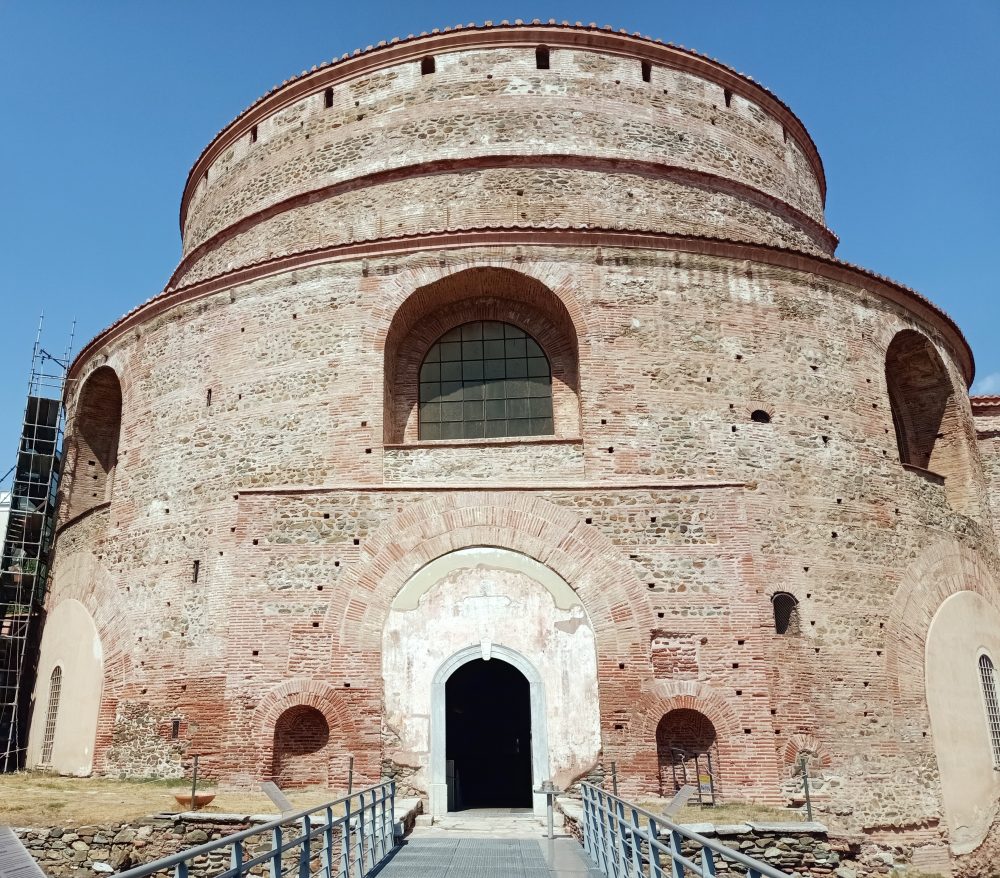
    With the late August morning dew glistening and the Sun peeking down on the byways and alleyways, patterns of food alchemy ring among the thronging speak of markets. Byzantine walls thrum their song lines, threading and circumventing the psychology of modern impulses. They tense with the pomegranate streets and “the lunches with views” that end at an edifice of red ochre, the Rotunda, sister to the Pantheon in Rome; crouching as a sphinx like riddle in the brightness.

    Hazy Sun coalesces the imperial eagles on the square close to the harbour, gazes piercing from the antique to the medieval. The arch of Emperor Galerius’s victory over the Persians is a formidable glimmer of the former, the white tower and seafront of Thessaloniki an inkling of the glories of its Eastern Roman, or Byzantine, successor.

    As pilgrims most often come first to Kathmandu for Tibet so the seaborne scent of Athos, the Holy Mountain of Christendom, comes on the wind and from behind the veil to Thessaloniki.

    The Rotunda of Galerius, Thessaloniki ©JL Roberts

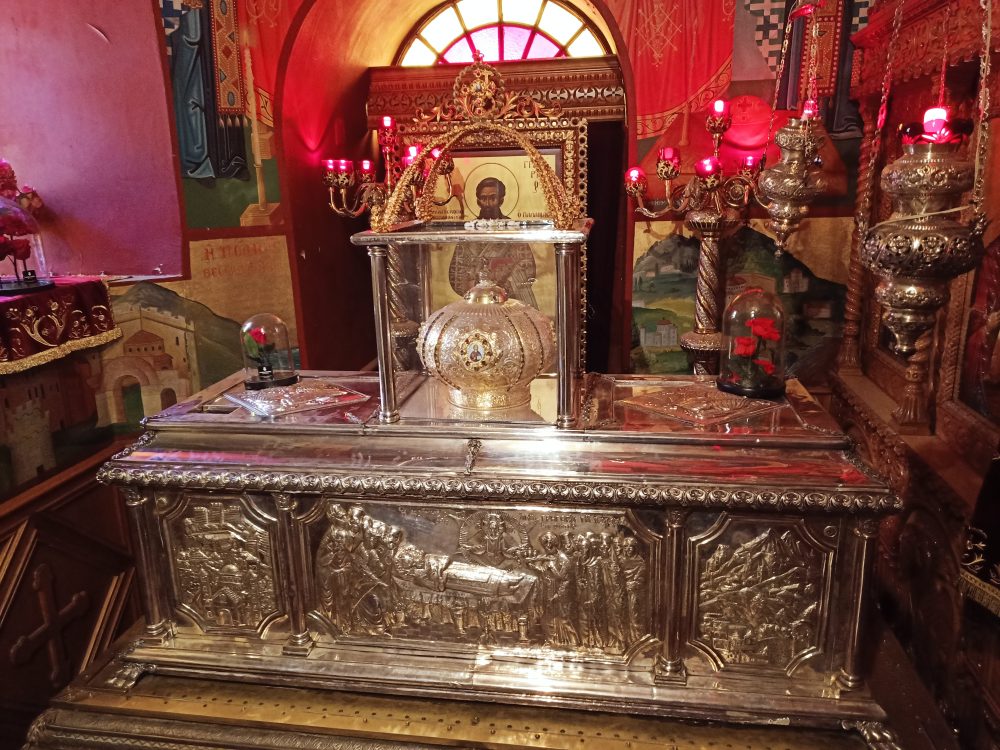
    Within, sapphire like, treasured, prominent, stands the shrine of Saint Gregory Palamas. To venerate his corporeal presence is to encounter the bedrock of Hesychasm, the Athonite Monastic method, or praxis.

    The breath of the moment, with the untarnished gold and silver metal below, is to ponder the divine in everything. Panentheism – “God is his essence and his energies”, paces in the byroads and the back alleys of the Church quarters about, then washes to the shores of the Holy Church of Saint Demetrius where an older energy awaits.

    Demetrius is a proto martyr of the Diocletian persecution’s last grasp to defeat the coming Christian revolution. In the crypt where he once lay, now below his reliquary, lies a resting catacomb of passages and ancient baths. Their turn to Christian use is eye opening – thousands attesting to a healing myrrh seeping visibly from his relics for hundreds of years. In this place of the mossy face of Christ, it is also the scent of the many miracle stories that will rise in the days ahead.

    Shrine of St. Gregory Palamas, Athos ©JL Roberts

    From Thessaloniki to Athos

    Gathering for pre-dawn whispers and the journey ahead, a healthily rotund font of folk wisdom gives greeting. A Jovian air ripples about him, and a fierce honest hospitality emanates from a Hephaestus heart. Conversing with all in all (the somnolent basking of psyche in company), the far off ancient of ancient days are declared.

    Utnapishtim’s ark emanates in the flowing, even as the eye (looking through cab windows) perceives the Sun rising and drenching the Grecian land in composite colours.  The glimmer of a far off lapus lazuli sea reaches out. Where once the world of appearances was wine dark, a new palate has arisen.

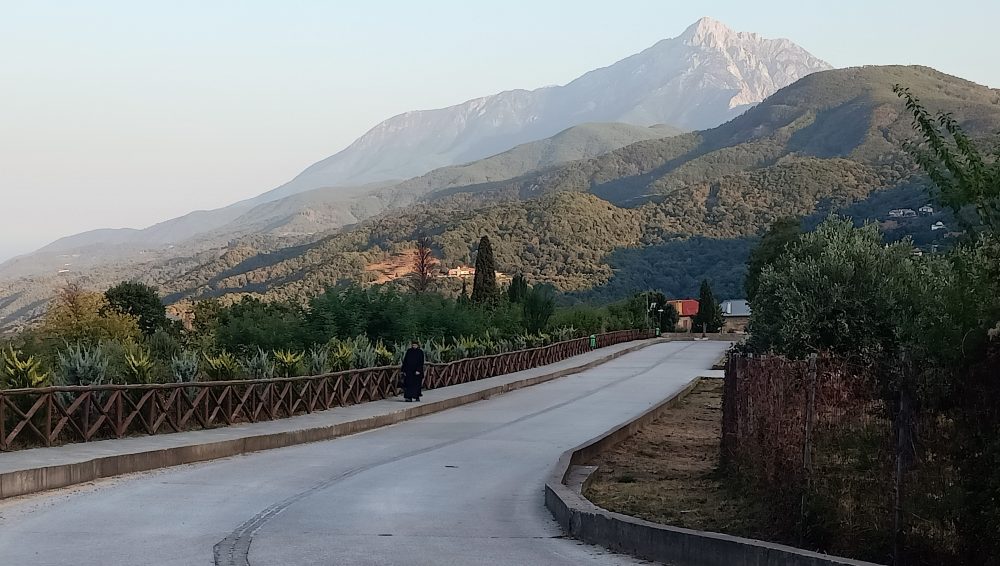
    Out ahead, at last, visible, stark, powerful, Athos. From the flanks – some 2000 metres high – his eye of mythos gazes back.   
 
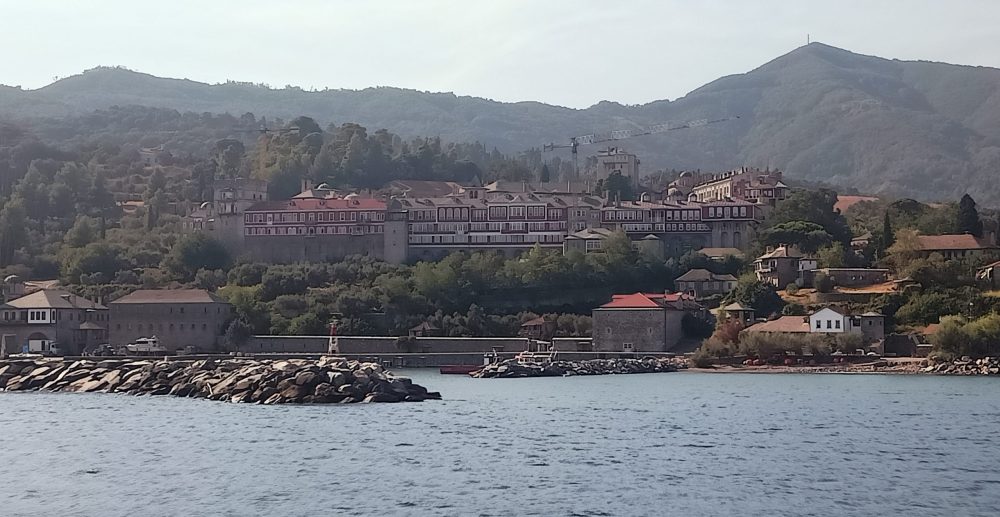
At the portable office by the Ferry point – the Greek emblazoned on the Certificate of Entry sides were as the Hieroglyphs on an Egyptian wall; till ‘Vatopedi’ became visible in the haze of meaning. Vatopedi, the “Bush Child”. Some one thousand years before, a lost princeling was saved from death by the Virgin Mary and a place of prayer and worship was born with his thankful beneficence.

    View of Vatopedi Monastery, Athos ©JL Roberts

    Vatopedi Monastery

    Through the sea and the hum of the up and the down, the west side of the Athonite peninsula appeared as a mottled tumult of wilderness. Coming about a side stretch of land was a first glimpse of seeming works of the Longaevi – reared and mystery shaped turrets with windows as honest eyes. Now we were bush children – filled with fresh thoughts since many long days of adulthood had taken them away.

    From the jetty riven and aesthetic forms rose, determinedly quoting heaven in their equations. By the entry way of this lunary promise a rural courtyard with a gnarled ancient olive dryad tended our feet and deposited us by a pond of crystal-clear waters. The koi’s languid strokes meant that passing through the thick-walled gates invoked their perspective of us as creatures moving through air. Soon we were ensconced in a long hollowed-out hall, the guest master plying to us fine liqueur and bowls of Byzantine Delight.

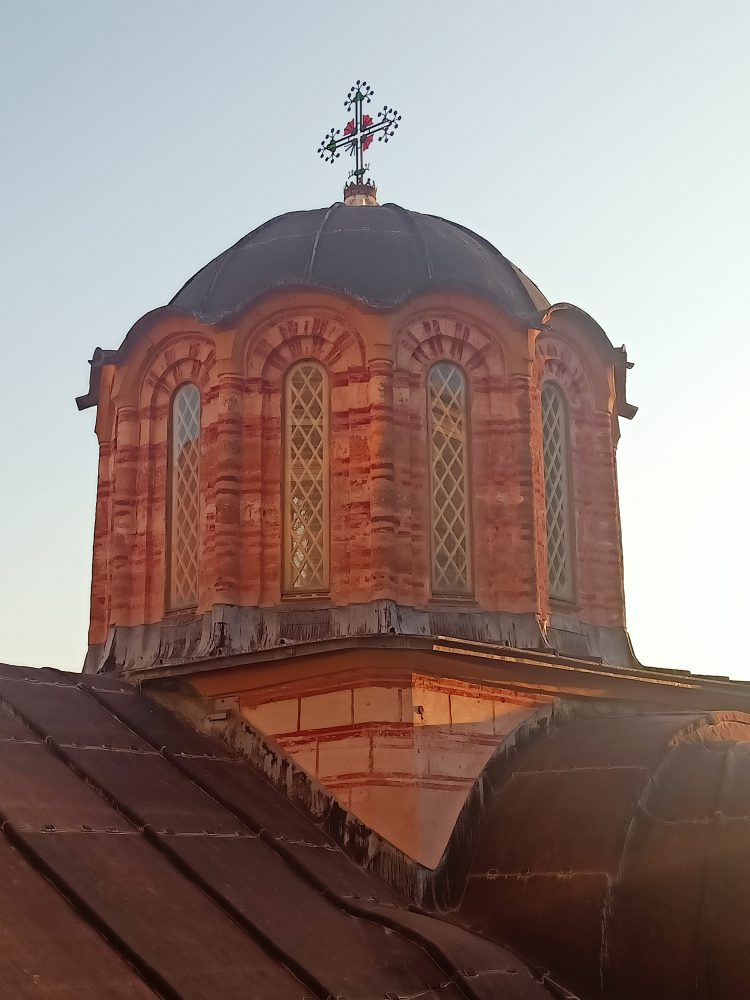
    In the Saturnine eve we sat and soon, the otherworld gathering, we moved among the shadowed globules of time and beauty encased within the main monastic Ekklesia or Church.

    Vatopedi, Athos ©JL Roberts

    The typical hours of the day began to slip away the outside world. It was old Byzantine reckoning: Matins was at 4am by our Greenwich system, Divine Liturgy followed shortly after for 7am, diverting into the many side chapels.

    The priests whispered to the Orthodox attending their request for Eucharistic preparedness: a true state of confession and the wise direction of their spiritual Fathers. Lunch at 9am follows in an upstairs dining hall and a sermon in Greek is given. As the days went by, the organism of Vatopedi grew clearer: the spiritual structure, the numerous bestriding monks, and the contingent of Greek Australians giving a surprising English language ambience.  A Greek Australian monk often translated for us.

    The day’s Light is time for contemplation, prayer, fasting, walks, or the library. Vespers follows for the eve, usually 5:30pm by Greenwich, with breakfast after. Veneration of the relics follows, and the various pilgrims present have a monk explain in their language the icons and the hallowed courtyard nearby.

    The chants rose round, the scent was cathartic, an earthquake struck – the rafters and ceiling shook and the wroth of Athos was displaced. And yet, the prayers must go on.

    To the Capital city of the Republic

    After three days we moved up the dusty gravel roads with views to rival those famous hills near Monaco, and came to the Holy Mountain’s capital, Karyes. As an autonomous Republic of Greece and of the European Union, Mt Athos has its own parliament and civil administration where the Abbots of the 20 monasteries, or their representatives, sit. Imperial Eagles stamped on the flying flags bear the historic weight of Ecumenical Patriarchs and Eastern ‘Pontifex Maximus like’ Caesars.

    Entering is to finally see what Robert Byron saw when he visited:
    “Of the Byzantine Empire…alone, impregnable, the Holy Mountain conserves both the form and the spirit.” (The Station, 1928)

    Skirting North-East, comes an ascent, whitewashed Russian Romanesque walls and glittering golden paint, serving God as a Christian High Place. The Skete of St Andrew’s was our provincial appendage to Vatopedi to frequent at. All Sketes, we discovered, are dependencies of the 20 monasteries of Mt Athos.

    Holding a fragment of the skull of St Andrew, the brother of Peter and first bishop of Constantinople, it is a recent reopen but with the regard of a major monastery to gird it. Abandoned 19th Century Russian architecture and iconography tells a tendril of the complex history of the Orthodox world; and of the Athonite fate of Russian monasticism abandoned by the Bolshevik revolution.

    The nearby Monastery Koutloumousiou – in a valley to the Southwest of Karyes – is of another order, with evidence of being older than 988 AD, though it was rebuilt in the heady dangerous days of the 13th century when pirates abounded. With icon wall paintings by the Cretan school, gifts from Byzantine emperor’s adorning it and relics such as St Anne’s foot (from the mother of Mary) and fragments of Mary of Magdala & Gregory the Theologian, it has the punch of a major monastery.

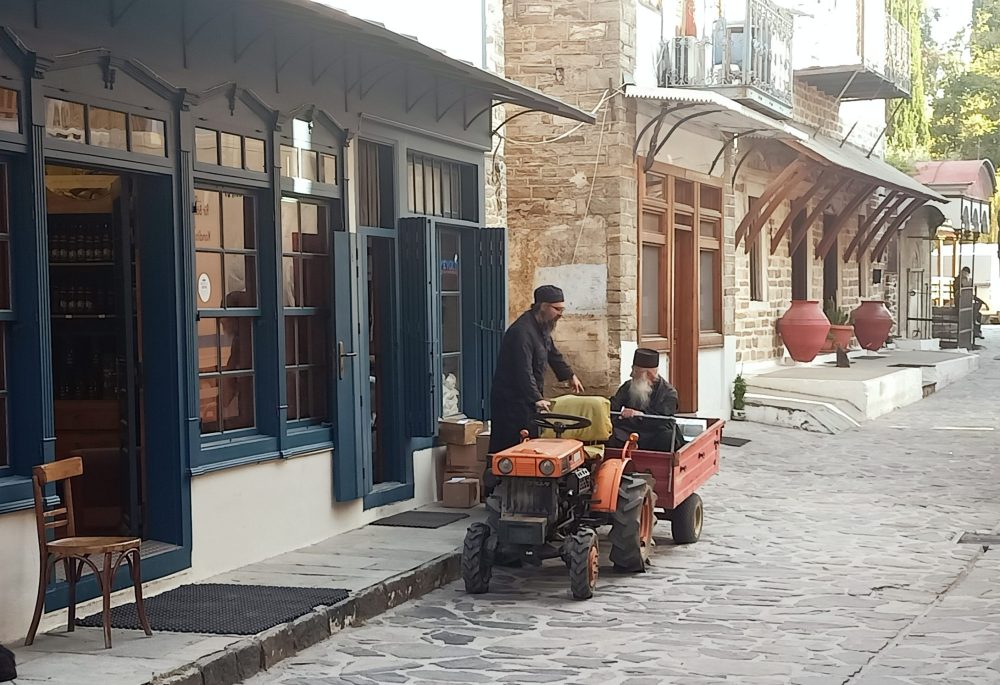
    Greeting us was the sub-Abbot, and we spent much time with a Gimli type character; a monk straight from the Kalevala, larger than life, a booming chuckle like Friar Tuck and a similar interest in grain-based brews.

    Capital City, Athos ©JL Roberts

    Daphne to Dionysiou

    In the beating heat and the somnolent shimmer, we left the running ridgelike landscape faced into the mount of Athos and came down to the main thoroughfare port of Daphne.

    Crystal clear waters arose again, fish schooling and darting. From the boats came the folk and the seekers, the agricultural Manus of Greece and the many wide lands of Orthodoxy present. Pilgrims, the curious, and the occasional West European; or more. It was exotic and purposeful and old and ancient.

    We were in a fairy tale. A prancing boat ride along a coast where cliffs rise and monasteries follow, began. Like pre-raphaelites come to their true home, we were in a co-imagined neo-medievalism, a kind of alternate possible world. One, it was suddenly felt, that might emerge again; out into the wide deserts of Shiny technocratic Barbarism, conquering it.

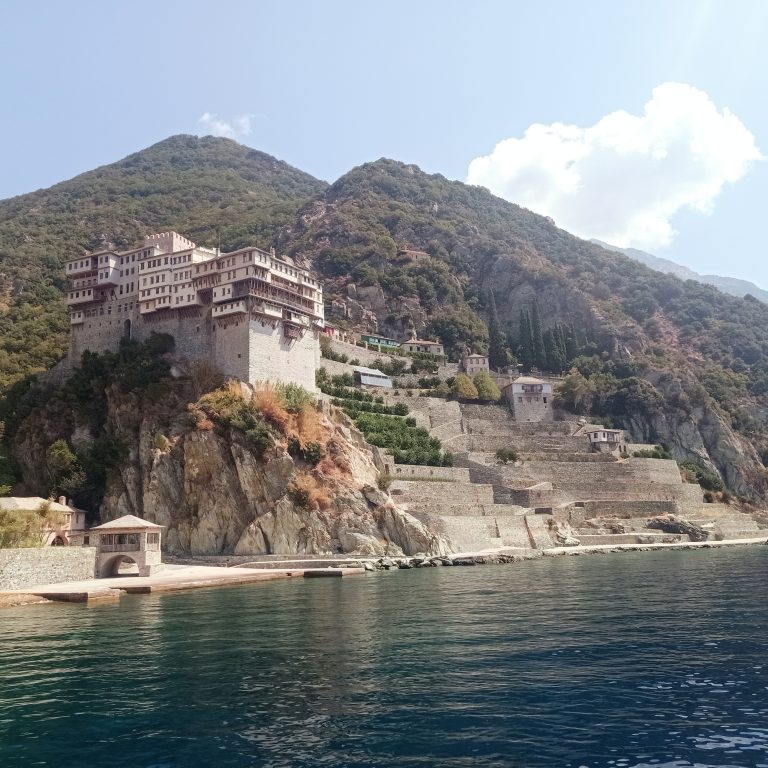
    The shades and the twists of land and man-made texture were rending, the hidden artist was at work – a Mysterium Tremendum beauty, with an orphic pneuma aeolian harp being played to view it. Now the last port hove to view, and the powering shadow of Athos was drawing overhead. We were at the Monastery of Dionysiou. Enchantment settled.

    Dionysiou, Athos ©JL Roberts

    Aslanic Dionysion days

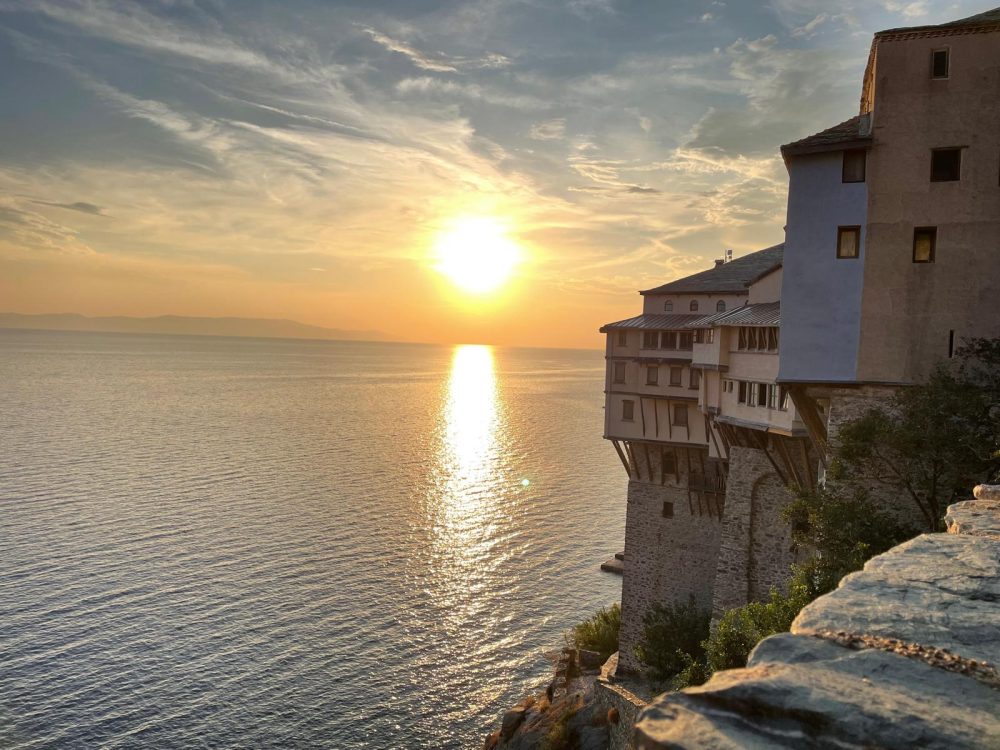
    The Monastery of Dionysiou is some 600 years old. Relics of St Mary Magdalene, John the Baptist & St George – among others – lie within. There is an icon of St Mary and the Christ Child (also once myrrh scented) – and attributed to the creation of St Luke, as other similar icons across old Christendom are. The monastery is gloriously situated, adorning rock and cliff face. The Sun kisses walls and lookout as each day ends with Blakean majesty.

    As the 3am call for Matins rings out each morning with clanged bell and wooden echo (the Semantron), the awakening process begins; Lazarus like. The energies of dawn peer through the simmering late dusk darkness. The ‘mantra similar’ ancient chant of the heart, the Jesus Prayer, rallies out to fight the counsels of despair with the power of Hesychastic love.

    As at Vatopedi, Divine Liturgy comes, and hearts present seek to chime with the music of the Light of the World. By such hearts, it is taught, spiritual light enters the Axis Mundi of the world.

    Agape lunch is the charity that follows, again by the ancient Byzantine reckoning that was also found at Vatopedi. Each day the food is rightly tuned to calendar and the correct form of fast. The Cretan school of iconic wall art paints the dining hall atmosphere. At the juncture, where church meets hall, are mysterious paintings of the 17th Century that prophetically hearken to the technical weapons of our time.

    By the Rivers of Vespers, where dinner and veneration of icon and relic combine (see the Seventh Ecumenical Council), there is contemplation, reading, meditation, prayer, or adventure to consider. All beckon.

    By olive twinned trees we set to the coastal way of St Paul’s monastery. Nestled in the full rise of the Athos Mountain, St Paul’s has one of the Great Icons, from which a living miraculous myrrh scent yet emits. Likewise, now almost expected, a story of wonder not unusual in our Byzantine surrounds, the treasures of the Magi – sceptical westerners notwithstanding – lie as gift of a great long-ago queen.

    In the light of such heritage the 20 Ruling Monasteries of the Autonomous Republic of Mt Athos are always at prayer, fasting and vigilance. At the Greenwich based 4am mark their matin prayers come together. With the Hesychasm breathing method, the monks chant their heart song of the Jesus Prayer for the whole world: “Lord Jesus Christ, Son of God, Have Mercy Upon Me a Sinner”.


    Departure

    For some of us the time for parting had come. Our erstwhile leader standing at the seashore of Dionysiou Monastery, waiting for our boat, set the tone for how to depart correctly: the herculean way. Stand like a pillar and ‘set to’.

    Athos ©JL Roberts

    Athos had been our pilgrimage and home for ten days. We were changed; we were part of the mythic. The otherworld, the invisible one of feeling and symbol, had been our master.

    The way back was a day pilgrimage all its own. The fellowship broke at the port of Daphne for some still staying. Those left of us parting Athos were taken past more mysterious sights on the boat out, each monastery unique and storied: high Xeropotamou, seashored Panteleimon, many pillared Dochiar.

    Then, the barrier point, we were back out into ‘the world’, the sand swept beach and Byzantine tower of Ouranoupoli soon present. The energy changed, the bathing suits on show a tangible example. But the vestiges of influence from Athos were striving through us, and our further parting to come felt somewhat looming; and much to give up.

    Finally, Thessaloniki. Three departed, two remained, our flight not far off in the evening, but far off enough to relax with the Sun sinking over a lovely bar by a handsome beach. With Spritz in hand the venture was done.

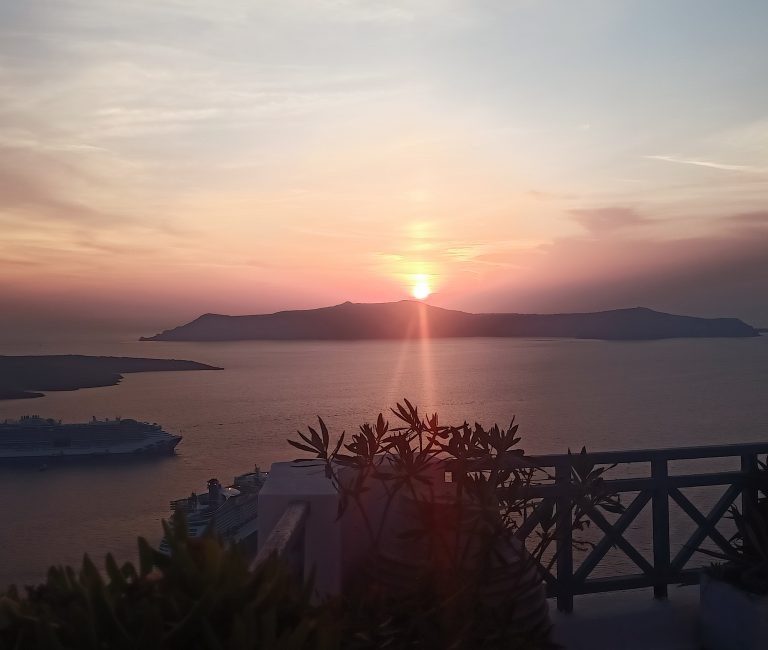
    Now Santorini awaited.